Mushroom Cave vs. Fruit Bat Cave: Which to Choose in Stardew Valley
In Stardew Valley, when your total income exceeds 25,000 gold, a character will visit your farm and ask you to choose between a Mushroom Cave or a Fruit Bat Cave. The cave on your farm will transform into the chosen type the next day. This choice can only be made once, and cannot be changed in-game. In this article, we will discuss the pros and cons of each cave option.
The Mushroom Cave
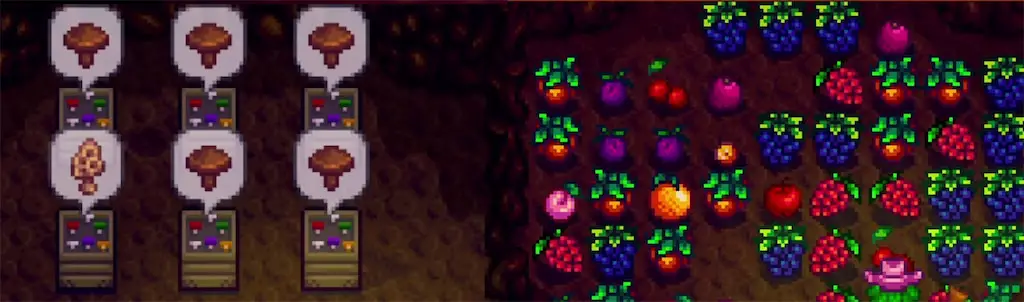
Choosing Mushrooms installs six Mushroom Boxes, not ordinary chests. In the current 1.6 machine data, an emptied box follows a two-day collection rhythm rather than producing a collectible mushroom every day. Choosing this cave also supplies a Dehydrator, which consumes five matching edible mushrooms and finishes Dried Mushrooms after one day.
The boxes produce normal-quality mushrooms. The sequential output rules result in approximately Common Mushroom 69.76%, Red Mushroom 12.31%, Morel 8.12%, Chanterelle 7.31%, and Purple Mushroom 2.5% per box. At base prices, six boxes average about 404g per collection, or roughly 202g per calendar day before processing.
The energy-to-gold ratio for each mushroom type is as follows: Common Mushroom (1.053), Red Mushroom (negative energy), Purple Mushroom (2), Chanterelle (2.13), and Morel (7.5). Compared to the energy-to-gold ratio of a salad (1.946), the Common Mushroom is better suited for energy replenishment. The other four mushroom types are best sold to buy salads, although Purple Mushrooms and Chanterelles can also be consumed directly without much difference.
Using mushrooms to craft Life Elixir is not recommended. A Life Elixir fully restores health and provides 200 energy, but crafting one costs 635 gold. When converted to the equivalent of salads, you can restore 144 health and 326 energy, making crafting Life Elixir inefficient in the early game.
The main tradeoff is routine versus consistency: the boxes provide predictable output every other day, while the Dehydrator gives five matching mushrooms a higher-value processing path. Uncollected output blocks that box from starting its next cycle.
The Fruit Bat Cave
Some players may think that the Fruit Bat Cave is filled with bats and might be hesitant to choose it. In reality, the Fruit Bat Cave is a place where bats bring fruits. There are a total of ten types of fruits in the Fruit Bat Cave, including four seasonal forage fruits and six tree fruits. The Fruit Bat Cave does not contain the Ginger Island additions of bananas and mangoes.
The fruit generation mechanism in the Fruit Bat Cave is quite complex. On average, one fruit is generated per day when the cave is empty. If there are fruits on the ground that have not been picked up, the probability of generating more fruits decreases. With half the cave floor covered, the average daily fruit generation is approximately 0.7.
The probability of generating each type of fruit is not equal. Forage fruits have a 20% chance, apples have a 2% chance, and other tree fruits have a 3.6% chance. If you pick up fruits after a long time, you will likely get about one apple every six months, one other tree fruit every month, and a small daily energy replenishment from forage fruits. Selling fruits is not very profitable, but the Fruit Bat Cave has several benefits:
1. Bundles: Tree fruit can fill slots in the Artisan Bundle. Fruit Bat Cave Apples can supply the three Apples for the Fodder Bundle, and a Pomegranate can supply the Enchanter’s Bundle. These are random drops, so plant trees or use the Traveling Cart when a deadline matters.
Fruit does not fill the Animal Bundle. The standard Animal Bundle accepts Large Milk, Large Brown Egg, Large White Egg, Large Goat Milk, Wool, and Duck Egg, and requires five of those six options. You still need suitable Coop or Barn animals, or another source for those animal products.
2.Foraging experience: Picking up fruits from the ground grants foraging experience points, which can accumulate over time and help level up your foraging skill.
3.Gifting: Fruits make great gifts for villagers, especially when they are their favorite items. For example, Elliott loves pomegranates, Robin adores peaches, and Gus is fond of oranges. High-quality fruits, boosted by your foraging skill, will earn you more friendship points.
Especially in the later stages of the game, the Botanist skill allows all foraged items to be of iridium quality, which would make fruits from the Fruit Bat Cave more valuable than planting your own fruit trees, which only produce iridium quality fruits in the fourth year.
Recommendations
For first-time players who do not want to follow a specific guide, we recommend choosing the Fruit Bat Cave to lower the requirements for unlocking the greenhouse, which can be particularly helpful for new players who might not know to plant fruit trees in advance or have the spare gold to do so. Unlocking the greenhouse early on can help with overall progress and provide a sense of accomplishment.
For experienced players or those following a guide, the Mushroom Cave offers predictable every-other-day output and a free Dehydrator. Planting fruit trees and raising animals is more reliable than waiting for specific bat-cave fruit. If you will not collect or process the Mushroom Boxes regularly, the low-maintenance Fruit Bat Cave may fit better.