
Mastering the Use of Scarecrows in Stardew Valley
A new farm starts with a package containing 15 Parsnip Seeds, not Fiber Seeds. Planting and harvesting those Parsnips provides enough Farming experience to reach Farming Level 1, which unlocks the Scarecrow recipe overnight.
Crafting Scarecrows
A Scarecrow requires 50 Wood, 1 Coal, and 20 Fiber. Coal can come from rocks, Dust Sprites, a Charcoal Kiln, or shops, while weeds are the usual early source of Fiber.
Scarecrow Function: Protecting Your Crops from Crows
At the morning crow check, the farm makes up to min(4, floor(crop count / 16)) attempts. Each attempt first has a 30% chance to activate, so a crow is never guaranteed just because the threshold was reached. This means 16–31 crops allow one attempt, 32–47 allow two, 48–63 allow three, and 64 or more cap at four attempts.
An activated attempt then looks for an eligible, unprotected crop. Crops in their earliest growth phases are excluded as targets, and a Scarecrow prevents eligible crops inside its range from being selected. Practical consequences:
- 31 crops still create only one attempt; the second begins at 32.
- An unprotected plot can survive many days because each attempt may fail or choose no eligible crop.
- Early-phase crops can count toward the total without being valid crow targets.
- The reliable strategy is still to place protection before expanding beyond 15 crops.
Additionally, there are no crows in the greenhouse or on Ginger Island, so you don’t need to craft scarecrows for those areas.
Scarecrow Coverage Area
The scarecrow’s coverage area is not a perfect square. It extends eight tiles up, down, left, and right and about six tiles along the diagonals. The shape contains 249 tiles including the Scarecrow’s own tile, so it can protect up to 248 crop tiles.
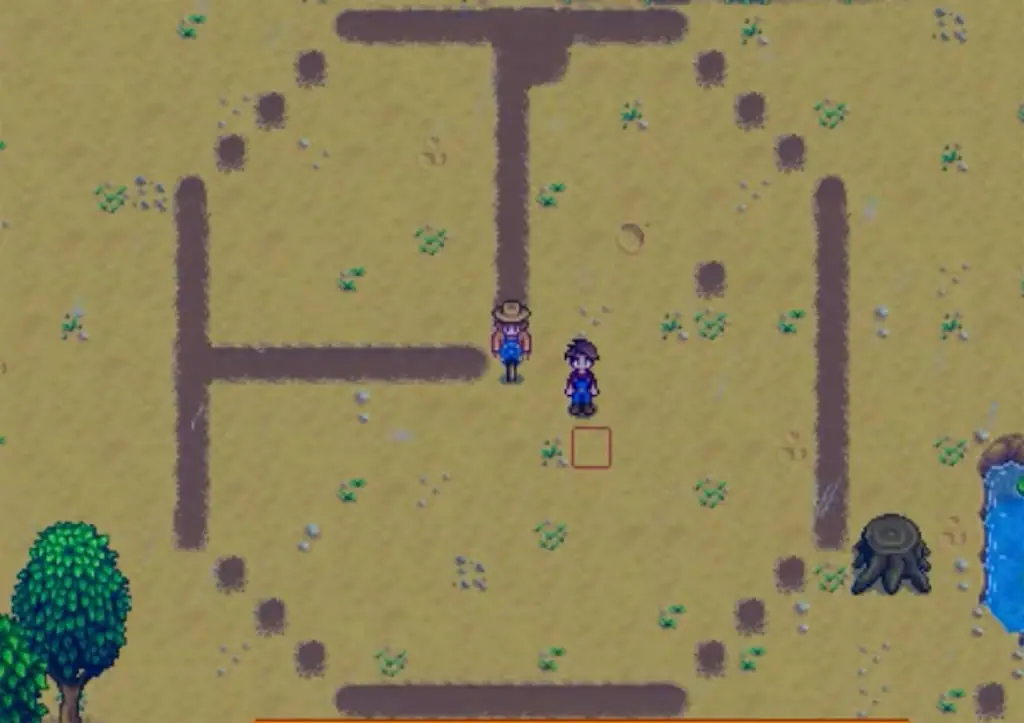
If you don’t have a mod to display the coverage area, it’s relatively easy to determine the range. Count eight tiles directly from the scarecrow for its boundary, then expand four tiles to each side, and connect the four sides to form the total area. You can also use the diagonal six tiles to determine the range.
As you can see, the scarecrow’s range is quite large. In the early game, one scarecrow placed in the center should be enough. It is recommended to determine the scarecrow’s position first and then plant crops around it.
Many players prefer to first connect their plots of land and then place scarecrows on either side or at the top and bottom. However, this approach can make it more challenging to determine the coverage area, especially when trying to ensure full coverage with multiple scarecrows. Due to the reasons mentioned earlier, it may not be immediately apparent if a crop is not covered by a scarecrow, and it might be eaten by a crow later on as it grows.
This arrangement can also lead to wasted coverage areas. Placing a scarecrow on each side may not provide a larger protected area compared to having one in the center. In the early stages of the game, the materials required for crafting scarecrows can be relatively high. Although placing scarecrows on both sides might save some space for planting, it might not be worth the trade-off in terms of coverage and resources.
Scarecrow and Sprinkler Combinations
There are many ways to arrange scarecrows and sprinklers. For example, with a basic sprinkler, you can place them diagonally in groups of three, which is suitable for planting hops in the summer. Another method is the zigzag arrangement, which may not be as convenient as the first method but looks better and makes it easier to remember the positions.
With a quality sprinkler, you can maximize the area by placing 21 sprinklers, but 15 should be enough. Arrange them in a modular square, and if you need to plant more crops, simply repeat the pattern without spending extra time planning.
Although there is space, it’s not recommended to leave empty rows in the middle, as it will affect harvesting efficiency. This is particularly evident for crops that require multiple harvests. For crops with fewer harvests, the impact is smaller, but it may still take up more space.
By following these tips, you can optimize your scarecrow usage and protect your crops in Stardew Valley.